Sulfate-Free Shampoo for Curly Hair: What Works and What Doesn't
Your curls deserve better than a shampoo that claims to be “gentle” but leaves your scalp feeling like it never got washed.
Most sulfate-free shampoos get one thing right and everything else wrong.
Rather than chasing the next hair care trend, it’s about choosing a curl shampoo that actually works.
Bottom Line
Sulfate-free alone doesn’t fix curly hair. In many cases, it creates new problems.
Curly hair needs real cleansing at the scalp. It needs controlled moisture through the lengths. When a shampoo is too gentle to remove oil and product buildup, curls lose definition, scalps overcompensate with oil, and wash day turns into a losing game.
Your curl type matters. Your scalp behavior matters more. A formula that works for straight or fine hair can fail curls completely—especially when heavy stylers are part of your routine.
Stop judging shampoos by what they exclude. Start judging them by results. Clean scalp. Balanced oil. Curls that hold shape without grease or frizz.
If your scalp feels calm, your curls stay defined past day one, and you’re not stuck in a constant clarify-and-reset cycle, you’re using the kind of shampoo formula The Wash was built to be.
The Real Problem With “Gentle” Shampoos
Sulfate-free has become the default recommendation for curly hair. And for good reason—sulfates can strip moisture and wreck curl definition. But here’s what nobody talks about: A lot of sulfate-free formulas swing too far in the other direction.
They’re so gentle, they barely clean. Your scalp stays oily. Product builds up. Your curls go flat.
Beyond avoiding sulfates, the goal is clean hair without wrecking your curls—or your natural moisture in the process.
Why Curly Hair Has Different Rules on Wash Day
Straight hair gets a natural assist from gravity. Sebum (the oil your scalp produces) travels down the hair shaft easily, distributing moisture from root to tip.
Curly hair? Not so much.
Not all curls play by the same rules.
Wavy hair (2A–2C) gets weighed down fast.
Curly hair, opens in a new tab (3A–3C) fights frizz and uneven definition. Coily hair (4A–4C) tends to be the driest and most fragile—especially at the ends.
That’s why blanket advice like “wash once a week” doesn’t work for everyone. Your curl types matter. So do your hair types. So does what your scalp is doing.
Those bends, coils, and spirals create roadblocks.
Oil pools at the scalp instead of traveling down. The lengths stay dry while the roots get greasy.
Add in the styling products most curly-haired people rely on, and you’ve got a recipe for buildup that weighs curls down and blocks moisture.
This is why wash day matters more for curly hair. You’re resetting your scalp’s balance and clearing the path for better curl care and a healthier curl pattern.
Curly hair is also more fragile. The raised hair cuticle structure, opens in a new tab¹ that gives curls their texture also makes them more vulnerable to damage from harsh cleansers.
“Sulfate-Free” Isn’t the Goal. Balanced Cleansing Is.
Sulfates earned their bad reputation for a reason. Sodium lauryl sulfate (SLS) and sodium laureth sulfate (SLES) are aggressive detergents.
They strip oil indiscriminately—including the natural oils your hair and scalp actually need.
For curly hair, that’s a problem. Stripped oils mean dry, frizzy strands and a scalp that overproduces oil to compensate.
So the industry pivoted to sulfate-free. And that’s where things got complicated.
Not all sulfate-free formulas are created equal.
Some replace sulfates, opens in a new tab with milder surfactants that gently cleanse while still creating a light lather. Others use ingredients that barely clean at all, or leave behind residue that accumulates over time.
The label “sulfate-free” tells you what’s not in the bottle. It doesn’t tell you whether what’s in there actually works.
Sulfate-free is the starting point. It’s not the finish line.
Signs Your Shampoo Isn’t Working for Your Curls
You might love the idea of your current shampoo. The packaging looks good. The ingredients list seems clean—silicone-free, no parabens, opens in a new tab, all the right buzzwords. But your curls tell a different story.
Your scalp still feels oily or itchy after washing.
If you’re washing and your scalp doesn’t feel clean, your shampoo isn’t doing its job. Gentle shouldn’t mean ineffective or leave behind flakes that turn into dandruff.
Your curls feel coated or limp.
That weighed-down feeling usually means residue. Either from the shampoo itself, opens in a new tab or from product buildup, it’s not removing.
Frizz increases instead of decreases.
A good wash should set the stage for defined, hydrated curls and better frizz control. If you’re getting more frizz after washing—not less—something’s off.
Definition disappears fast.
Healthy curls stay bouncy. If your definition drops within hours of styling, buildup or moisture imbalance could be the culprit.
You’re washing more often but seeing worse results.
Over-washing with the wrong formula creates a cycle: your scalp overproduces oil to compensate, so you wash more, and the cycle continues.
If any of this sounds familiar, the shampoo might be the problem—not your hair.
What to Look For in the Best Shampoo for Curly Hair
Skip the ingredient lists for a second. Focus on outcomes.
✅ Cleans thoroughly without stripping.
Your scalp should feel genuinely clean. Not squeaky—that’s a sign of over-stripping. But refreshed. Balanced.
✅ Supports scalp comfort.
No tightness. No itchiness. No flaking. A good shampoo works with your scalp, not against it.
✅ Rinses clean.
Residue is the enemy of curl definition. You shouldn’t feel like there’s a film left behind that makes detangling harder later.
✅ Keeps curls light, defined, and touchable.
The right formula enhances your natural texture. Heavy, greasy, or crunchy curls after washing? Wrong product.
✅ Doesn’t require a “transition period.” Your hair shouldn’t get worse before it gets better. If a shampoo needs weeks to start working, it’s not the right shampoo.

A good hydrating shampoo should restore balance, not mask buildup. A truly moisturizing shampoo never leaves hair feeling coated.
One more variable people forget: porosity.
If you have high porosity hair, moisture escapes fast—so you can feel dry even when you’re using hydrating products.
If you have lower porosity hair, heavy formulas can sit on top and leave you feeling coated instead of truly nourishing your hair.
Translation: the best shampoo isn’t the one that sounds the most moisturizing. It’s the one that cleans your scalp and lets your conditioner and stylers actually do their job.
Look for pH-balanced formulas.
Your scalp’s natural pH hovers around 4.5 to 5.5. A shampoo that matches that range causes less disruption and requires less recovery time.
And pay attention to how your hair behaves over multiple washes—not just the first one. Consistency matters.
If you use gels, creams, oils, or a lot of leave-ins, you don’t just need “gentle.” You need a routine that prevents buildup from gels and product film, especially if you use multiple hair care products throughout the week.
That’s where clarifying shampoo comes in. Not every wash. Just often enough to reset.
When buildup sticks around, it can trigger an itchy scalp, make a dry scalp feel worse, and even irritate a sensitive scalp—because nothing is rinsing truly clean.
How Often Should You Wash Curly Hair?
There’s no magic number.
And anyone who tells you that is oversimplifying it.
Most people with curly hair do well washing every 2 to 4 days. But the real answer is: wash when your scalp needs it.
The “wash once a week” advice floating around online works for some people. For others, it leads to scalp issues, itchiness, and limp curls weighed down by buildup.
Your ideal wash frequency depends on the following factors.
Your scalp’s oil production.
Some scalps run oilier than others. If yours does, less frequent washing can backfire.
How much product you use.
Heavy stylers like gels, creams, oils made with things like coconut oil or argan oil need to be washed out. Otherwise, they accumulate and suffocate your curls.
Your activity level.
Sweat is real. If you’re active, your scalp needs washing more often, opens in a new tab.
Your environment.
Humidity, pollution, hard water—all of it affects how quickly your hair gets dirty.
Pay attention to how your hair feels. Don’t let arbitrary rules override what your hair is telling you.

How to Wash Curly Hair So It Stays Defined
There’s no magic number.
And anyone who tells you that is oversimplifying it.
Most people with curly hair do well washing every 2 to 4 days. But the real answer is: wash when your scalp needs it.
The “wash once a week” advice floating around online works for some people. For others, it leads to scalp issues, itchiness, and limp curls weighed down by buildup.
Your ideal wash frequency depends on the following factors.
The product matters. But technique matters too.
Fully saturate your hair first.
Don’t rush this. Let water run through your curls for at least 30 seconds before applying anything. Dry spots don’t get clean.
Massage your scalp, not your lengths.
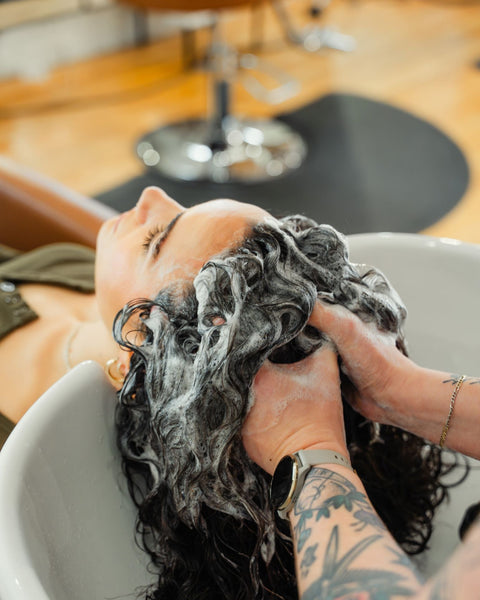
Your scalp is where the oil and buildup live. Use your fingertips (not nails) to massage in small circles. Work the product through your scalp for at least 60 seconds.
Your lengths don’t need aggressive scrubbing. The rinse water will carry cleansers through them naturally.
Rinse longer than you think you need.
Most people under-rinse. Residue left behind weighs curls down and attracts more dirt. Rinse until the water runs completely clear—and then rinse a little more.
Condition only where you need it.
For most curly hair, that’s mid-lengths to ends. Your scalp produces its own oil…it doesn’t need extra help. Conditioner on the roots can lead to that greasy, flat look at the crown.
Think of shampoo & conditioner as a system. If the cleanser doesn’t reset your scalp, no conditioner can fix the fallout.
Don’t rough up your curls with a towel.
Friction is frizz’s best friend. Gently squeeze excess water out with a microfiber towel or soft t-shirt. Scrubbing with a regular towel destroys curl definition.
Small adjustments to your wash routine can make a bigger difference than switching products every month.
Where Our Wash Fits In
We built The Wash after hearing the same complaint over and over: “It’s sulfate-free… but my hair still feels dirty.”
It’s sulfate-free. But more importantly, it’s pH-balanced.
Formulated to match your scalp’s natural acidity so there’s no disruption, no overcorrection, no greasy adjustment period.
The Wash cleanses thoroughly without stripping. It removes buildup, excess oil, and product residue while leaving your hair’s natural moisture intact.
No transition phase.
No greasy roots while your scalp “adjusts.”
Works from the first wash.
The formula is built on botanicals that support scalp health. Because healthy curls start at the scalp.
If you want sulfate-free that actually delivers a real clean, that’s The Wash, opens in a new tab.