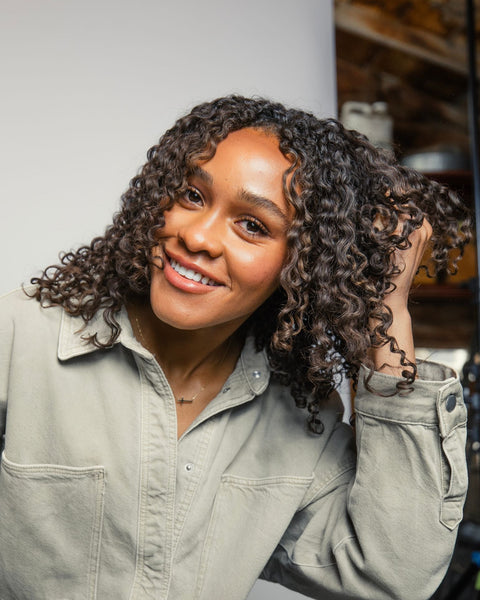
Coily Hair Explained: What 4A, 4B, and 4C Mean
Your hair care products aren't failing because you're doing it wrong; you just haven't found the right products. They're failing because they weren't built for your hair type.
Type 4 hair sits at the most complex end of the natural hair spectrum. What works on 4a coils can actively wreck 4c strands, and most products don't tell you which one they're designed for.
Know your Type 4 pattern. Fix everything else from there.
4a, 4b, and 4c aren't interchangeable labels. Each one has a different coil structure, handles moisture differently, and needs a different approach to product and a tailored hair care routine that addresses its specific hair needs.
Get that match wrong, and no technique saves you.
This guide breaks down exactly what coily hair is, how the Type 4 sub-types differ, and what each one needs to maintain optimal hair health and hold moisture and definition past day one.
That’s why we crafted Glacial Clay Pomade and Glacial Cream—both designed to work with your hair, not against it.
This is your complete step-by-step guide and tutorial to Type 4 coily hair with subtypes, daily care, and styling that works with your coily pattern instead of fighting it.
What Is Coily Hair?
Coily hair is the tightest, most textured end of the natural hair spectrum, often mistaken for simply curly hair or even wavy hair, due to its unique curl pattern.
Understanding coily hair vs other types is crucial for proper care.
It covers everything from springy S-coils in Type 4a through to the dense, near-invisible zigzag pattern of Type 4c.
It's also the driest. The tighter and more angular the coil, the harder it is for natural scalp oils to travel from root to tip.
That means Type 4 strands live in a near-constant moisture deficit, which is why hydration isn't a step you can skip. It's the foundation everything else sits on.
The truth about shrinkage
Type 4 hair can shrink 70–80% of its stretched length when dry. That's not damage. That's not a lack of moisture. It's the elastic response of a structurally healthy strand.
Hair that retains moisture and has intact protein bonds snaps back.
If your Type 4 has stopped shrinking, pay attention…that's when something's wrong. Shrinkage is the baseline, not the problem.
Where Type 4 Fits in the Hair Typing System
The Andre Walker system runs through various curl types, from Type 1 (straight) through to Type 4 (coiliest). Type 4 is the natural hair category with coils so tight that the usual rules of curl care simply don't apply.
If you're unsure where your hair sits, our full hair classification guide breaks down every sub-type visually.
It matters because 4a and 4c need different products, different techniques, and different routines. Treating them as the same thing is the source of most Type 4 frustration.
4a, 4b, and 4c: What Each One Truly Means
Type 4 covers a significant range. The gap between 4a and 4c is a real difference in coil structure, moisture capacity, and how each sub-type responds to product.
Type 4A
4a hair forms tight, springy coils with a clear S-shaped pattern, often described as corkscrew curls. It's the most visibly defined of the Type 4 range.
Still dry, still prone to significant shrinkage, but it holds defined curls relatively well and responds to lighter products without getting weighed down.
🌱 Main challenge: heavy products. Rich butters and thick pomades sit on 4a strands instead of being absorbed, leaving hair coated and greasy rather than moisturized.
🌱 Needs: Lightweight moisture that absorbs cleanly. Flexible hold that works with the S-pattern. Frizz control without any stiffness.
Type 4B
4b hair bends at sharp angles in a z-shaped pattern rather than spiraling. Less visible coil definition, much denser structure.
Those sharp bends are natural weak points. 4b is more fragile than it looks, and dryness makes breakage far more likely during manipulation.
🌱 Main challenge: breakage. The Z-pattern means every bend is a stress point, making it crucial to detangle with care. Styling dry 4b hair is one of the fastest ways to cause damage.
🌱 Needs: Deep moisture, often achieved through deep conditioning, before any styling step. Richer hold that keeps the strand pliable.
Gentle handling with no raking, no dry styling, and always use a heat protectant if applying heat.
Type 4C
4c is the densest, tightest end of Type 4. The coil pattern is so compressed that individual strands may show almost no visible curl definition; the hair appears as a dense cloud.
Shrinkage can hit 75–80%+. It's simultaneously the most high-maintenance sub-type and the most underserved by mainstream hair care.
🌱 Main challenge: everything is harder. Moisture escapes fastest. Products absorb least predictably. Day-two definition is the hardest thing to achieve.
🌱 Needs: Rich conditioning moisture on thoroughly damp hair. Hold that defines without drying further. Consistent scalp care to prevent buildup blocking hydration at the root.
The 3 Mistakes Type 4 Hair People Keep Making
1. Wrong product weight
A butter formulated for 4c flattens 4a coils. A gel that defines 4a delivers zero conditioning to 4c. Product weight has to match the sub-type rather than just the broad category.
The rule: tighter and drier the pattern, the richer the formula needs to be.
🧴 The Wash was developed with botanical cleansers, no sulfates, and no adjustment phase. It cleans without setting your moisture balance back to zero every time.
2. Applying to the wrong dampness level
Product on dry Type 4 hair sits on the surface instead of bonding with the strand.
You get surface coverage, not conditioning, and a crunchy finish that cracks by mid-morning.
Apply to damp hair every time. Not dripping wet, not dry. The window between those two is when Type 4 is most receptive.
Check out our detailed guide on how to use hair cream.
3. Inconsistent wash schedules
Over-washing strips the natural oils that Type 4 barely retains, especially with harsh cleansers.
Under-washing lets product and sebum stack up at the scalp, blocking moisture from reaching the shaft.
For 4a and 4b, washing every 7–10 days is typical. For 4c, 10–14 days. The real signal is when the scalp starts to feel heavy, and product stops distributing evenly.
At Highland, we believe great hair starts with the right care.

What Type 4 Hair Really Needs
Moisture that goes in rather than just sits on top
Products that coat the outside of the strand look moisturizing. They're not.
Type 4 needs humectant ingredients that draw water into the hair shaft and emollient ingredients that lock it there.
Without both, moisture evaporates before you've finished styling.
Vegetable glycerin is the standout humectant for coily hair. It binds moisture to the strand and consistently outperforms heavy oil-based butters for day-two retention on Type 4.
💧 Glacial Cream is great for type 4 hair. Light-control, matte finish, adds moisture and curl definition without the weight that kills loose spirals. Scrunch it through wet hair, diffuse it on low, go out and seize the day.
Flexible hold, not a rigid cast
Gels and waxes with high alcohol content create hold by forming a stiff film on the strand.
You get definition for a couple of hours, then crunch, then breakage as the dried film cracks under movement.
Flexible, conditioning hold is what actually lasts on Type 4. It enhances the coil without fighting it.
Scalp health
4c especially is vulnerable to product buildup. The tight coil pattern and dense growth make it hard to fully clear heavy products from the scalp.
Mineral oil, silicone, and wax-based ingredients layer over time and create a barrier that stops moisture reaching the root.
Switching to water-soluble formulas lets the scalp breathe between wash days.
How to Style Type 4 Coily Hair
✅ Start on damp hair. For 4b and 4c, this isn't optional. Even slight dryness during product application causes breakage and uneven absorption.
✅ Section before you start. Type 4 is dense. Four to six sections, depending on thickness. Unsanctioned application gives patchy coverage and frizzy roots.
✅ Scrunch in and don't rake. Raking product through coily hair disrupts the coil pattern. Scrunching encourages each coil to form and hold its shape. Takes longer (worth it).
✅ Leave it alone while it dries. Touching Type 4 hair during drying breaks coil formation and turns definition into frizz. Avoid excessive heat styling. Air dry or low-heat diffuse. Stay out of it until completely dry.
✅ Refresh 4b and 4c between wash days. Mix a small amount of cream with water in your palms and scrunch into second or third-day hair. 4c loses moisture faster than any other sub-typ and this step buys another day or two of definition.
💧 Glacial Cream covers all of this. It’s a light-control matte styling cream with botanical ingredients that condition while they hold.
No silicones, no sulfates in the formula, and versatile enough to work across all three Type 4 subtypes.
Why Product Formulation Matters More Than You Think
Most Type 4 routines don't fail because of technique. They fail because the product was built for a different pattern.
The industry defaults to two extremes: thick butters for 4c that flatten 4a coils, and lightweight gels for loose curls that do nothing for 4b and 4c strands fighting dryness at every step.
Glacial Cream was formulated to sit between those two extremes.
Light enough not to weigh down 4a coils. Rich enough to condition 4b and 4c through to the next wash day.
It works as both a styling product and a leave-in conditioner, which means it handles two jobs in one application window.
FAQs
What's the difference between 4a, 4b, and 4c?
4a has a defined S-coil and is the most flexible to style. 4b has a Z-pattern zigzag with less definition and more fragility at the bends.
4c has the tightest, least defined pattern, the most shrinkage, and the highest moisture demand. Most people with Type 4 hair have a mix, commonly 4b in some sections and 4c in others.
Why does Type 4 hair shrink so much?
Because the coil structure compresses dramatically when dry. 4c can shrink 75–80%+ of its actual length.
High shrinkage signals healthy elasticity with strands retaining moisture and protein structure snap back. Reduced shrinkage on Type 4 is the warning sign, not the other way around.
How often should I wash 4c hair?
Every 10–14 days is the typical range for 4c. Over-washing strips oils that 4c barely retains to begin with. Read our blog for gentler ways to cleanse Type 4 hair.
The signal to wash is when the scalp feels dense and heavy, and product stops distributing evenly through the hair.
Can I use a styling cream on color-treated Type 4 hair?
Yes, and it matters more here than anywhere else. Color processing opens the cuticle, making already-porous 4b and 4c strands, regardless of their natural porosity, even more prone to moisture loss.
A conditioning cream replaces what the color process removes. Use sulfate-free, silicone-free formulas. Glacial Cream is safe for color-treated hair with no stripping and no buildup.
Make it Highland
Your natural curl is more valuable in the long run than a temporary straight style.
Show your coily hair some love and it will love you back.
Pomade
For sleek, structured styles that hold their shape.

✅ Best for: Straight Hair (1B, 1C), Wavy Hair (2A, 2B), and some Curly (3A) Hair Types
🔹 Why You’ll Love It:
• Locks in your style with a clean, medium-firm hold—without stiffness or greasiness.
• Adds a natural matte finish with just the right amount of texture.
• Keeps flyaways and frizz under control, even in unpredictable weather.
• Rinses out easily, thanks to our 9 all-natural ingredients.
💇♂️ Best Styles for Pomade:
✔ Slicked-back styles (Straight 1B, 1C)
✔ Side-part & comb-over (Wavy 2A, 2B)
✔ Pompadour or Quiff (Straight 1C, Wavy 2B)
✔ Defined curls or waves (Curly 3A)
New to it? Here's exactly how to apply pomade for the best results
Hair Cream
For effortless, touchable styles with natural movement.

✅ Best for: Wavy (2B, 2C), Curly (3A, 3B), and Coily (4A, 4B, 4C) Hair Types
🔹 Why You’ll Love It:
• Lightweight & hydrating—gives your hair that soft, natural look without the crunch.
• Enhances waves and curls, making them defined yet touchable.
• Tames frizz while keeping your hair flexible and easy to restyle throughout the day.
• Packed with nourishing ingredients to support healthy hair, keeping it strong, vibrant, and looking its best.
💇♂️ Best Styles for Styling Cream:
✔ Messy, textured waves (Wavy 2B, 2C)
✔ Soft, natural curls (Curly 3A, 3B)
✔ Defined, moisturized coils (Coily 4A, 4B, 4C)
✔ Medium-length, effortless styles for a relaxed, lived-in look.
Not sure which to pick? Blend them. Use the Cream first to hydrate and define, then finish with a small amount of Pomade for added structure and hold. Best of both worlds.
Want Only the Best for Your Hair?