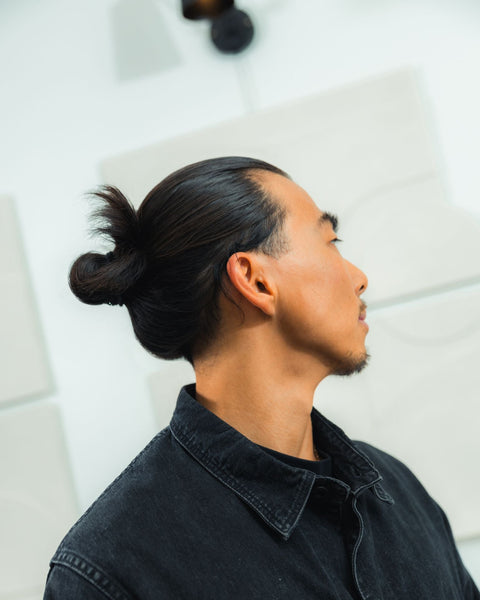
Straight Hair Types 1A, 1B & 1C Made Easy
Straight hair has a reputation. Easy to manage. Low-maintenance. Boring, even.
Wrong on all three counts.
The most versatile hair type on the planet, once you understand it, whether styling with a round brush or simply air-drying.
Straight hair can be sleek, textured, structured, or effortlessly relaxed. It holds shine better than any other type.
It responds immediately to good product and good technique. But it also shows everything…every drop of oil, every wrong product choice, every missed step in your routine.
Once you know your subtype and what it needs, straight hair stops being a problem and starts being a serious advantage.
That’s why we crafted Glacial Clay Pomade and Glacial Cream—both designed to work with your hair, not against it.
This is your complete hair care guide for Type 1 with subtypes, daily hair routine, and styling that holds.
Part of our full hair type classification guide, covering all four types from straight to coily.
What Is Straight Hair?
Straight hair, classified as Type 1, grows without any curl or wave pattern. The strand emerges from a round follicle, which produces a perfectly cylindrical hair shaft. No bends, no spiral, just a smooth line from root to tip.
That round follicle is also why straight hair gets oily faster than any other type. Natural scalp oils (sebum) travel down a straight shaft without obstruction.
On curly hair, the coiled structure slows that journey. On yours, it's a straight run all the way to the ends.
That's just biology. The fix is in your routine, not a different hair type.
The Three Subtypes: Are You 1A, 1B, or 1C?
Not all straight hair is the same. Type 1 breaks down into three subtypes based on hair texture and strand thickness. Getting this right is the difference between styling that works and styling that flops.
Quick self-test: Wash your hair with a gentle, sulfate-free shampoo. Let it air-dry completely with no blow-drying, no product. Once dry, look at a single strand.
Type 1A: Pin Straight, Ultra Fine
Your strand is almost invisible. No bend anywhere from root to tip, dead straight. It lies flat against your scalp and has very little volume on its own.
If someone's ever described your hair as thin hair, this is likely why.
🌱1A is actually the rarest straight subtype. Most common in East Asian hair.
If this is you, your hair has exceptional shine, but styling it is a game of weight management. Anything too heavy and it collapses completely.
The tell: after air-drying, your hair lies completely flat with zero movement.
- Main challenge: volume and hold. Thin hair's smooth surface gives pomade almost nothing to grip onto.
Type 1B: Straight With Natural Movement
The most common straight hair type. Your strand is medium in thickness and has a slight natural bend or bounce to it, usually at the ends. It doesn't form a wave, but it's not dead-flat either.
1B is the most versatile of the three subtypes. It holds straight hairstyles better than 1A, doesn't frizz like 1C, and responds well to almost any lightweight styling product.
The tell: hair air-dries with a hint of movement or body at the ends…not flat, not wavy.
- Main challenge: oiliness at roots, keeping styles from falling flat by midday.
Type 1C: Thick Hair, Coarse, Full of Volume
Your strand is noticeably thicker than 1A or 1B. Thick hair like this has serious body, volume, and the kind of natural movement that looks styled even when it isn't.
But it also resists styling more than the other subtypes, gets frizzy in humidity, and needs more product to stay in check.
1C hair sometimes gets misidentified as 2A wavy hair. The difference: 1C air-dries with body and volume but no defined S-shaped wave pattern, though it can be prone to flyaways.
The tell: air-dries full and voluminous with some texture, but no visible wave.
Main challenge: frizzy strands, particularly in humidity. Thick hair needs more grip from products than 1A or 1B.
What Straight Hair is Good At
Credit where it's due. Natural hair at its best (no heat) is where straight hair genuinely shines.
Natural shine: the smooth, flat cuticle reflects light better than any other hair type. Straight hair has a natural gloss that's hard to replicate.
Versatility: it can be worn sleek and structured, or texturized and lived-in. Few hair types can do both.
Clean lines: barber cuts read clearly on straight hair. Fades, tapers, and undercuts all look sharp when the hair above is straight.
- Easier styling than most people give it credit for: you don't need a diffuser, special tools, or a 10-step routine. The right product, applied correctly, is usually enough.
The Challenges and How to Handle Them
Oiliness
🌱 Straight hair produces the same amount of sebum as other hair types; it just distributes faster.
The solution isn't to wash more often. It's to build a hair routine that works with your scalp, not against it.
Every 2–3 days is the ideal frequency for most straight hair types.
Daily washing strips your scalp and triggers it to produce even more oil in response, making the problem worse, not better.
For washing: use a gentle, sulfate-free formula that cleans without stripping.
🧴 The Wash is designed exactly for this with lightweight botanical cleansers that reset the scalp without throwing your oil balance off. One product, no adjustment phase.
When conditioning: ends only. Applying conditioner, especially a leave-in conditioner, to your roots speeds up the oiliness noticeably.
Flatness and Holding a Style
Straight hair doesn't grip product the way curly or wavy hair does. The smooth hair texture gives product less to hold onto, which is why heavy formulas weigh it flat.
The fix is in the formula type, not the amount. You want grip, not coat.
A product that provides structure and a little texture, not one that seals everything flat and shiny.
Timing matters too. Apply to 80% dry hair, not soaking wet. Wet application dilutes product and delivers even, heavy coverage, which is exactly the opposite of what straight hair needs.
Frizzy Strands (1C Specific)
Type 1C hair has coarser, wider strands that absorb humidity. In damp conditions, the cuticle swells slightly, and that's what makes it frizzy.
A lightweight styling product applied to slightly damp hair creates a barrier that keeps moisture out and the cuticle smooth.
Pre-shampoo before washing — apply oil before shampoo to protect against moisture loss. For some, co-washing can also be beneficial.
Use the LOC method (Liquid, Oil, Cream) after washing to lock in moisture in layers.
Protective styles (braids, twists, buns) cut down on daily manipulation and breakage.
Always detangle from the ends up. Never start from the root.
At Highland, we believe great hair starts with the right care.

How to Style Straight Hair, By Subtype
Styling 1A
A single small amount of product applied to the roots is all that's needed. Anything more and the hair will fall completely flat.
Best styles: blunt bob, classic slick-back, sharp side part, or a clean blowout for volume.
Avoid: any product with heavy wax, silicone, or oil since they collapse thin hair immediately.
- Volume trick: using a blow dryer upside down before applying any product gives the roots a lift gravity can't take back. Keep the heat on medium. Fine hair is more vulnerable to heat damage than coarser types.
Styling 1B
This is the most forgiving subtype to work with. A pea-to-dime-sized amount of a medium-hold matte product, applied to 80% dry hair, worked through from roots to ends.
💧 Glacial Clay Pomade is the natural fit here. Medium hold, matte finish, no silicone, no grease. It gives 1B hair structure without flattening it, and it's reworkable throughout the day without needing to reapply.
Best styles: textured crop, side part, slick-back, French crop.
Technique: warm between palms, rake through hair, then refine with fingertips.
- Amount: start small. You can always add…you can't take away.
Styling 1C
1C needs more grip than 1B but more moisture than 1A. A good approach: a small amount of Glacial Cream worked through slightly damp hair to add texture and control frizz, followed by a dime-sized amount of Glacial Clay Pomade to structure and define.
Used together, they cover both the moisture and hold that coarser straight hair needs without weighing it flat.
Best styles: textured, lived-in looks. Works well with long hair lengths and layered cuts.
Avoid: anything described as "smoothing,” which often means silicone, which creates buildup on 1C hair fast.
What to Look for in Products for Straight Hair
The checklist is short. Get this right and most other things sort themselves.
✅ Medium hold, matte finish: straight hair's shine speaks for itself. You don't need gloss from a product on top of it.
✅ No silicones: silicones coat rather than grip. On straight hair, they create buildup and kill volume.
✅ No heavy waxes: too much weight. Fine and medium straight hair can't carry it.
✅ Lightweight formula: product should feel like it disappeared into your hair, not like it's sitting on top of it.
🧴Glacial Clay Pomade and Hair Cream tick all of these. It's also reworkable, which is useful for straight hair that you want to adjust throughout the day without going brittle.
Common Straight Hair Mistakes
Applying to wet hair: wait until hair is 80% dry. Wet application dilutes product and creates an even, heavy layer that flattens everything.
Using too much: 1A hair needs a fingertip. 1B and 1C need a dime-size at most. Over-application is the most common reason straight hair looks greasy after styling.
Ignoring the roots: roots are where volume lives. Work product in from scalp outward, not just through the lengths.
Washing too often: daily washing with a stripping shampoo teaches your scalp to over-produce oil. Space washes to every 2–3 days.
Wrong cut for the type: 1A needs blunt cuts for thickness illusion. 1C needs layers to manage bulk. Talk to your barber or stylist about what works for your specific subtype and desired haircut.
Overdoing heat tools: blow-drying and using a hair straightener or flat iron daily causes heat damage over time: dry ends, breakage, and a loss of that natural straight hair shine. Use medium heat, always a protectant, and opt for heatless air-drying when you can to minimize heat styling damage.
FAQs
What type of hair is straight?
Straight hair is classified as Type 1 in the standard hair typing system. It has no curl or wave pattern and is subdivided into three types: 1A (ultra fine and flat), 1B (medium with some natural movement), and 1C (thick, coarse, with volume). Your subtype determines your best hair care approach and hair routine.
Is straight hair rare?
1A (pin-straight, ultra-fine) is the rarest subtype, most commonly found in East Asian populations. 1B is one of the most common hair types globally. 1C is widespread across many ethnicities.
Why does my straight hair get oily so fast?
Because of your follicle shape. The round follicle of straight hair produces a straight shaft, and sebum (natural scalp oil) travels down it with zero resistance. There's no curl to slow it down. This is normal. The fix is washing frequency (every 2–3 days) and scalp-focused conditioning, not a different hair type.
What hairstyles suit straight hair?
Almost all of them, depending on your subtype. 1A and 1B work well with side parts, textured crops, slick-backs, and undercuts. 1C can carry more volume like quiffs, longer textured styles, and layered cuts work well. Avoid overly complex styles that require heat-tool maintenance daily.
Can straight hair hold a curl?
1A rarely holds a curl. 1B holds one better but usually needs a product to set it. 1C holds curls reasonably well, given its coarser texture. All three lose curls faster than wavy or curly hair types. The smooth shaft doesn't grip the curl pattern, even with hairspray or bobby pins.
Does using a hair dryer damage straight hair?
Blow-drying is fine in moderation. Daily use at high heat is where heat damage starts. For thin hair (1A), medium heat and keeping the dryer moving prevent hot spots. For thick hair (1C), a blowout can actually help smooth frizzy strands and add shape. Use a heat protectant spray either way.
Make it Highland
Pomade
For sleek, structured styles that hold their shape.

✅ Best for: Straight (1B, 1C), Wavy (2A, 2B), and some Curly (3A) Hair Types
🔹 Why You’ll Love It:
• Locks in your style with a clean, medium-firm hold—without stiffness or greasiness.
• Adds a natural matte finish with just the right amount of texture.
• Keeps flyaways and frizz under control, even in unpredictable weather.
• Rinses out easily, thanks to our 9 all-natural ingredients.
💇♂️ Best Styles for Pomade:
✔ Slicked-back styles (Straight 1B, 1C)
✔ Side-part & comb-over (Wavy 2A, 2B)
✔ Pompadour or Quiff (Straight 1C, Wavy 2B)
✔ Defined curls or waves (Curly 3A)
New to it? Here's exactly how to apply pomade for the best results
Hair Cream
For effortless, touchable styles with natural movement.

✅ Best for: Wavy (2B, 2C), Curly (3A, 3B), and Coily (4A, 4B, 4C) Hair Types
🔹 Why You’ll Love It:
• Lightweight & hydrating—gives your hair that soft, natural look without the crunch.
• Enhances waves and curls, making them defined yet touchable.
• Tames frizz while keeping your hair flexible and easy to restyle throughout the day.
• Packed with nourishing ingredients to support healthy hair, keeping it strong, vibrant, and looking its best.
💇♂️ Best Styles for Styling Cream:
✔ Messy, textured waves (Wavy 2B, 2C)
✔ Soft, natural curls (Curly 3A, 3B)
✔ Defined, moisturized coils (Coily 4A, 4B, 4C)
✔ Medium-length, effortless styles for a relaxed, lived-in look.
Not sure which to pick? Blend them. Use the Cream first to hydrate and define, then finish with a small amount of Pomade for added structure and hold. Best of both worlds.
Want Only the Best for Your Hair?