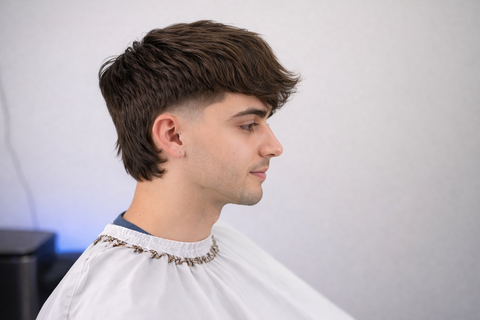
The Medium Mullet That You Want (Without Heat, Guesswork, or Bad Barber Results)
Your mullet looked great leaving the chair. Two days later? Flat, greasy, disconnected.
Most medium mullet guides show you inspiration photos and call it a day. Nobody talks about why your hair collapses after washing, why the sides puff up on day three, or why you can't recreate the texture your barber built.
This tutorial fills that gap. You'll get a barber script you can screenshot, a no-heat styling system that holds, and a simple hair care strategy that doesn't require a shelf full of hair tools.
What a "Medium Mullet" Actually Means
A mullet hairstyle goes beyond "business in the front, party in the back." That vague definition is exactly why so many cuts go wrong.
The modern mullet haircut is more refined than the classic mullet your uncle had in 1987, opens in a new tab¹. It's about intentional layering, clean contrast between lengths, and flow that looks styled rather than accidental.
Unlike the old school mullet, opens in a new tab with its stark contrasts, the medium version offers more versatility.
Here's what medium length actually looks like:
Top: 3–5 inches. Enough to style with texture, not so long it flops.
Sides: Shorter than the top, but not disconnected. This is where your taper or fade choice matters.
Back: Flows past the collar or hits mid-neck—that longer back still needs weight removal and blended layers so it moves instead of sitting like a curtain.
If your sides look like they belong to a different hairstyle than your back, your barber missed the blend.
If everything looks smooth and helmet-like instead of tousled and lived-in, you're missing the scissor work that makes modern mullet cuts work.
Medium Mullet Variants Worth Knowing
Wolf cut mullet
Heavy layering, shag-inspired texture, best for wavy hair or curly hair with natural movement.
Burst fade mullet
⚡The burst fade curves around the ear. Creates bold contrast. Works well on oval face and square face shapes.
Shaggy mullet
Intentionally messy, laid-back vibe. Low-maintenance once you nail the routine.
Low fade mullet
Fade mullet that starts low near the ear, more versatile for professional settings.
Textured modern mullet
What most people actually want. Clean tapered sides, layered mullet top with movement, defined flow at the back.
Curly mullet, opens in a new tab
Lets natural curl pattern, opens in a new tab² do the heavy lifting.
Permed mullet
For straight hair that wants the curly mullet, opens in a new tab look, opens in a new tab. Trending again for that retro-modern vibe.
See our complete guide to types of mullets, opens in a new tab for all variations.
The Barber Script: What to Say
Bad communication creates bad haircuts.
Before the Cut
Bring reference photos with front, side, and back views. One photo isn't enough. Your barber needs to see the hairstyle from multiple angles.
Tell them your hair type honestly. If it's fine and goes flat, say that. If it's thick hair and puffs out, say that.
The Script
For the sides: "I want a [low/mid/high] taper (or fade), opens in a new tab that blends into the top without a hard line."
For the top: "Leave 4–5 inches with texture. I want scissor work,” (point cutting or texturizing shears).
For the back: "Let the back flow past my collar, but thin out any bulk so it has movement."
For the finish: "Style it with product before I leave so I can see how it's supposed to look."
Fade vs. Taper
Taper fade
Keeps hair at the shortest point with no skin showing. Softer transition, grows out gracefully.
Low fade
Starts near your ear. Still clean, less stark contrast.
Skin fade
Blends to bare skin. Sharp, dramatic, requires maintenance every 2–3 weeks.
For most mullet hairstyles, a low taper fade gives you the best balance. Unless you want bold contrast, then go fade mullet.
Face Shape Considerations
Oval face
Most mullet styles work.
Square face
Softer layers on top balance strong jawlines.
Round face
More volume on top and tighter sides create vertical emphasis.
Heart-shaped face
Keep the back from getting too wide.
Before You Leave: Mirror Checks
Side profile
Does the blend look smooth, or is there a visible shelf?
Crown area
Is there texture, or does it look flat?
Back flow
Does it have movement, or sit heavy?
If something looks off: "Can you take a little more weight out of [area]?"
Hair-Type Decision Tree
Fine or Straight Hair
What happens: Flat crown by lunch. Products weigh it down.
What matters: Lightweight products only. Volume at roots.
Products that work: Texturizing powder, matte hair clay, opens in a new tab (small amounts), mousse for root lift.
Wavy Hair
What happens: Good shape on day one, then sides puff out and back gets frizzy.
What matters: Enhancing natural wavy hair pattern. Controlling frizz without flattening texture.
Products that work: Styling cream, curl-enhancing cream, texturizing spray.
Curly Hair
What happens: Frizz in the back. Crown loses definition. Products create crunch.
What matters: Moisture balance. Definition without crunch. Letting curls clump naturally.
Products that work: Curl cream, smoothing serum on ends, hydrating leave-in conditioner.
Thick Hair
What happens: Too much volume. Sides puff. Back gets bulky.
What matters: Weight removal at the cut. Products that control, not add volume.
Products that work: Styling cream, opens in a new tab for smoothing, matte clay for texture without puff.
The No-Heat Styling System
Heat tools work—a blow dryer and diffuser can add volume and enhance curls. But this system gets you texture and hold without them.
Step 1: Wash Right
What you want: Clean hair that doesn't feel squeaky or stripped.
If your cleanser leaves residue, products sit on top. If it strips too aggressively, your scalp overproduces oil. Both kill your style.
For heavy product users, a clarifying shampoo once a week resets things.
Step 2: Dry Right
Towel-dry method: Squeeze and scrunch. Don't rub—that creates frizz.
Target dampness: 70-80% dry. Not dripping, not bone dry.
Fine hair exception: Go slightly drier (80-90%) before applying product.
Step 3: Add Texture First
Texture creates the foundation. Hold locks it in. Skip texture and you get a stiff, helmet-like result.
Application: Pea-sized amount. Work through mid-lengths and ends first, then scrunch into crown. Don't start at roots.
For fine hair: Texturizing powder or lightweight molding paste.
For wavy/curly hair: Scrunch upward. Don't rake through.
Step 4: Lock Shape (If Needed)
⚡Not everyone needs this. If your texture product gives enough hold, skip it.
When to add hold: Crown collapses within hours. Style falls flat by afternoon.
Where to apply: Crown first. Light application on sides. Back usually doesn't need much (the weight of long hair provides its own hold).
Product Categories That Make Sense
Matte Clay
Best for fine to medium hair that goes flat. Absorbs oil, creates texture. Don't use too much hair clay—it builds up.
Styling Cream / Curl Cream
Best for wavy to curly hair. Hydrates, defines natural texture, controls frizz. Don't expect strong hold.
Pomade / Matte Pomade
Best for slicked-back styles and shorter mullet hairstyles. Pomade is good for, opens in a new tab a strong hold, reworkable. Too heavy for fine hair.
Molding Paste
Best for maximum texture with pliable hold. Works across most hair types.
Texturizing Powder
Best for fine hair that needs volume without weight. Absorbs oil, adds grip at roots.
Mousse
Best for fine or straight hair needing root lift. Curly mullet definition without crunch.
The rule: One texture product. One hold product (if needed). That's it. Stacking creates buildup.

Fix-It Guide
Flat crown
Product too heavy or applied at roots. Switch to lighter product, apply to mid-lengths first.
Greasy
Product buildup or over-application. Use less. Do a clarifying reset weekly.
Sides puff
Cut issue, not product issue. Ask barber to thin sides more.
Frizzy back
✨Moisture imbalance. Scrunch-dry instead of rubbing. Use product with conditioning element.
Disconnected look
The cut. No product reliably saves a bad blend. Go back or find someone who understands layering.
Where Highland Fits
Your styling products can only perform as well as your wash step allows.
If your cleanser leaves residue, every product sits on that film. If it strips too aggressively, your scalp overproduces oil.
Highland's approach: clean without stripping. Balanced pH means no greasy transition period. No sulfates means your scalp doesn't go haywire.
If you only change one thing: Get your wash step right. A clean, balanced foundation makes every styling product work better.
Maintenance
Trim cadence
Every 4–6 weeks for most cuts. Every 3–4 weeks for fade mullet styles. The longer back grows fastest.
Wash frequency
💧Fine hair every 1–2 days. Wavy every 2–3 days. Curly every 3–4 days. Thick hair every 2–3 days.
Weekly reset
Clarifying wash, thorough rinse, air-dry without product. Clears accumulated residue.
FAQs
Fade or taper for a medium mullet?
Taper fade for most. Grows out gracefully, keeps the lived-in vibe. Fades require more maintenance.
How much product is too much?
If you can see it (shine, clumping, residue), you used too much. Start pea-sized.
What’s the difference between a wolf cut and a medium mullet?
Wolf cut has heavier shag influence, shaggier silhouette. Textured mullet is more structured and intentional.
Will a medium mullet work for fine hair?
Yes—with lightweight products, proper drying, and extra layering for volume.
The Takeaway
Most modern mullet failures come from three places: miscommunication at the barber, wrong product for your hair type, or a wash step that sabotages everything.
🌱Get the cut right. Match products to your actual problems, not whatever's trending. Start on hair that's balanced.
🌱No heat required. No guesswork. Just a system that works.
🌱Ready to reset your routine? Shop The Wash →